
Looking for Ararat
A 50th birthday on the border of Türkiye and Iran, while marvelling at the twin peaks

May 18, 2025. It’s the day I turn 50, and we have arrived outside our (unusual for us) upmarket accommodation - the Tehran Hotel - the closest we can safely get to Iran on a British passport. Ahead of me I have the day to look at Mount Ararat, fabled resting spot of Noah’s ark. Can birthdays get any better?
We are in the town Doğubayazıt, locally known as Bazîd. It’s a border town my father once passed through some 52 years ago when he hitchhiked and bussed along the informal ‘hippie trail’ from the UK to Asia. The town was the entry point for those travelling from Europe by thumb, bus or VW van, and meet fellow travellers, share stories, preparing for the challenging routes ahead through Iran and Afghanistan.
When we were there in 2025, crossing this border was limited due to regional tensions. The main Gürbulak-Bazargan checkpoint was operational for cargo, but access for foreigners varied with the state of the world. As it was, our bus travelling from the lakeside Turkish town of Tatvan passed a few checkpoints, though this was likely as much due to being a Kurdish area as the Iran border 38km away from Doğubayazıt - the road passing even closer.


Nostalgic backpackers writing in ‘hippie trail’ Facebook groups describe Doğubayazıt “as a small Kurdish town famous only for smuggling” and “like the edge of the world. Dust everywhere, and the constant, looming presence of Ararat.” Reading traveller reports ahead of our arrival in 2025 it seemed there was not much change in people’s indifference, but we had a few days here and wanted to make our own impressions.
I will admit it was a little dusty on arrival - the town sits at about 1600 meters above sea level, atop an arid plain that our bus travelled over - little vegetation, an endless horizon that winds blow across, bringing dust and topsoil. We went straight to a lokanta lunch where we think we were over charged (or chose badly) an occurrence so frequent on our travels because we arrive hungry - that we now call it the “first meal blow-out”.
The town was initially a little disorienting and while very functional, it didn’t seem particularly well-to-do, there’s little development and economic investment in this predominantly Kurdish town. Dried and salted boxes of fish lined the streets along with white cheese in briny tubs. Bags of onions and potatoes hung from shops, painted advertising on walls promoted dairy, meat and other local goods. It was a hazy, grey, cloudy day, not what I had ordered on my birthday, and Mount Ararat was hiding.


Despite the grey sky we wanted to do something spectacular for a birthday memory, and Jon suggested we take the local minibus up to the palace, even foregoing caffeine to do so.
In the 1970s, Doğubayazıt was apparently a notorious bottleneck for truck drivers and travellers, so border officials and locals sought bribes to expedite people through passport control and customs. Perhaps that has lingered in the genes of the town’s present day bus drivers, as the custodian of our sluggish mini van charged us a steep 50 lira on the way up and half of that on the way back, miming it was cheaper going down hill! We felt prepared for subsequent journeys, and firmly asked for our change when the bus driver “forgot” to give it to us and enlisted locals to help us extract it. Once a kindly old man leaned across to give us the correct price and added some thoughts about what he thought of dodgy bus drivers, which needed no translation!
As we passed out of town, the minibus became quickly crowded so we gave up our seats, but if Ararat was to reveal itself, standing blocked our view of the windows.
Our destination was Ishaq Pasha Palace the largest remaining Ottoman palace - a building admirable in itself but also located in such a daring position that it was breathtaking. The Palace is perched on the edge of a high natural platform overlooking the Doğubayazıt plains and the old Silk Road routes, a vantage point that allowed the Pasha to control trade. The audacity of building there in the 1600s is impressive.
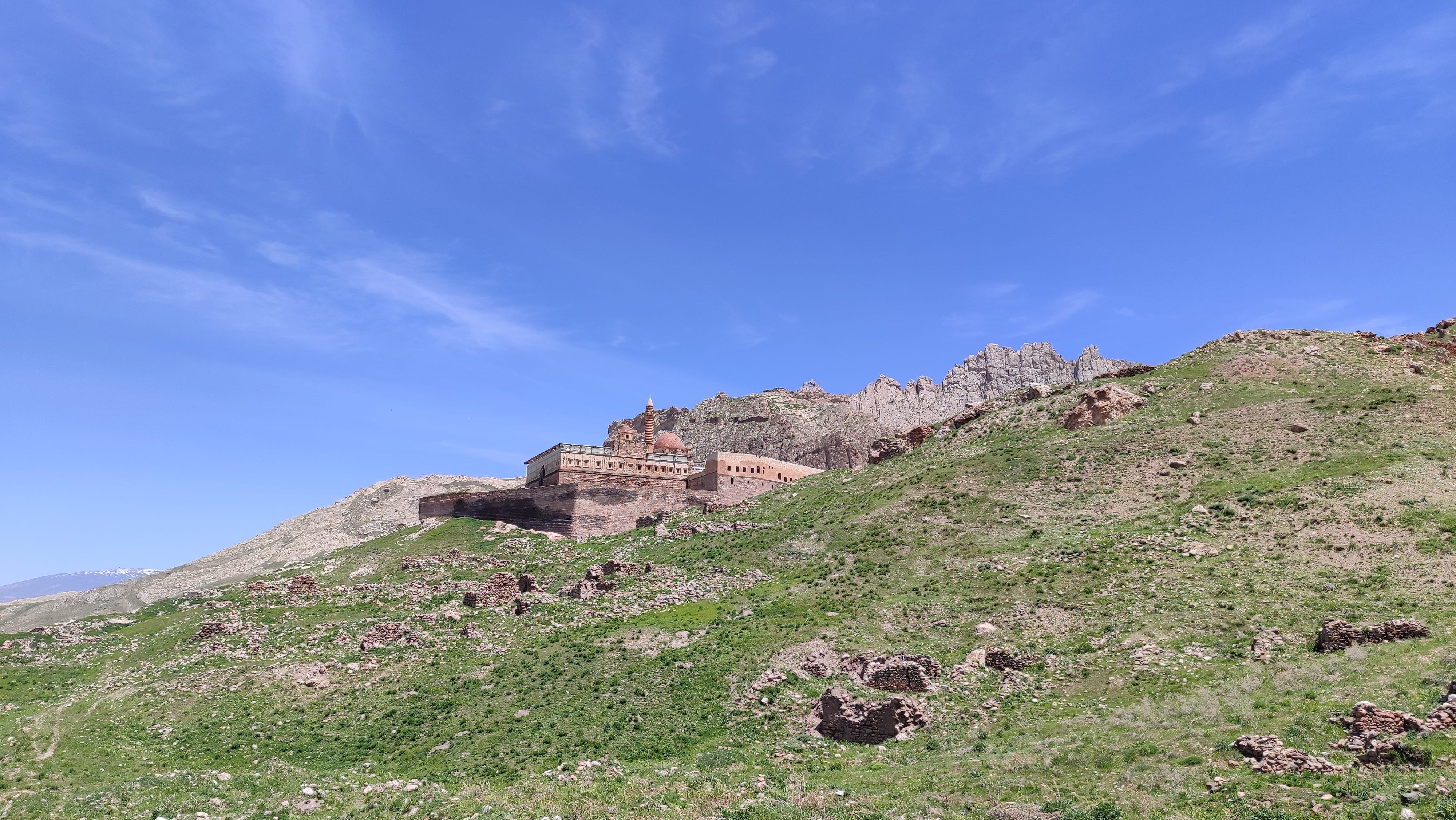
But on arrival what could have been a jewel of Turkish tourism and history was quite frankly a bit of a mess. It was a busy weekend - parking was haphazard with domestic tour buses parking and reversing on the fast eroding roadsides. Graffiti marked the non-historical buildings, rubbish (both individual and fly tipped) was dotted across the area, there were simply not enough bins and absolutely, no order, people were BBQing everywhere! It was quite the contrast to the well managed sites of Göbeklitepe which has corporate management and Nemrut Dağı which while state run has university involvement and UNESCO World Heritage status (both of which the Palace is trying to get).
We kept our viewing to a minimum, entertained by the squeak of a ground squirrel hiding from picnickers, and awed by the stunning Dolomite-reminiscent landscape towering above the trash and BBQ smoke. The mountain - the famous Ararat - was not in sight but that was expected for a grey day, I thought.


And so we went back up to the palace on a blue sky week day, the first minibus of the day climbing slowly to 2000m. The weekend rubbish was cleared and we were gifted with free entry and the place to ourselves. We explored the seemingly endless complex of rooms, the darkness of the prisons, the thick walls of the harem and the windows of longing looking out across the vast landscape below (but not, I noted, to Ararat). We were dazzled by the ornate doorways, the wild grass taking residence between the stones of the domed roof, and the stone steps worn in the middle by the passing of concubines and eunuchs, servants, spies and scholars, caravan commanders, local leaders and frontier soldiers to name a few.
Jon beckoned me over to another doorway, this one with a heavy wooden door and a shoe rack beside it, and sock-footed, I pushed it open to find the high domed ceiling of a beautiful mosque, jaw dropped in surprise to see the spaciousness of it in the middle of an internal cluster of rooms and Jon‘s enjoyment at my delight and surprise.
The Palace took 100 years to build, boasts one of the world’s first central heating systems featuring clay pipes keeping the many wives warm enough in the brutal winters. We noticed two fountains in the wall as we left which were said to have flowed with milk and honey-water as the ultimate flex of wealth - or excess.


But what of the views of Ararat on this clear day - you may rightly ask?! Well, dear reader, there are none! The palace complex faces the Doğubayazıt plain, but the massive volcanic cone of Ararat is situated behind the high ridges that flank the palace’s location. It is simply not visible from the palace no matter what the postcards, guidebooks, the internet or even the locals tell you.
One local legend says the Pasha was so jealous of the mountain’s majesty that he ordered the palace to be built in a way that the mountain could never be seen - ensuring his own Palace was the centre of attention. The legend goes further to say that the Pasha was so pleased with the palace that he had the architect’s hands cut off to prevent him from ever creating something more beautiful. Another tale suggested that the Pasha was incensed that anything could be bigger and more majestic than him that he declared that he should never be able to see it. An ancient male inferiority complex?
So how did the hunt for the elusive Ararat continue? Well let it be known, that on my first morning waking up in Doğubayazıt all I could think about was the mountain - as if I had some localised version of Jerusalem Syndrome. I rose early leaving Jon comfortable in bed and went to the hotel’s top floor so I could check on the view of the mountains all around us from every angle, watching for an opening in the cloud. It was partly obscured that morning but I kept going back to “check on the mountain” while Jon was working. I hadn’t known at the time that the mountain is notoriously shy, obscured for some of the year by lenticular clouds.
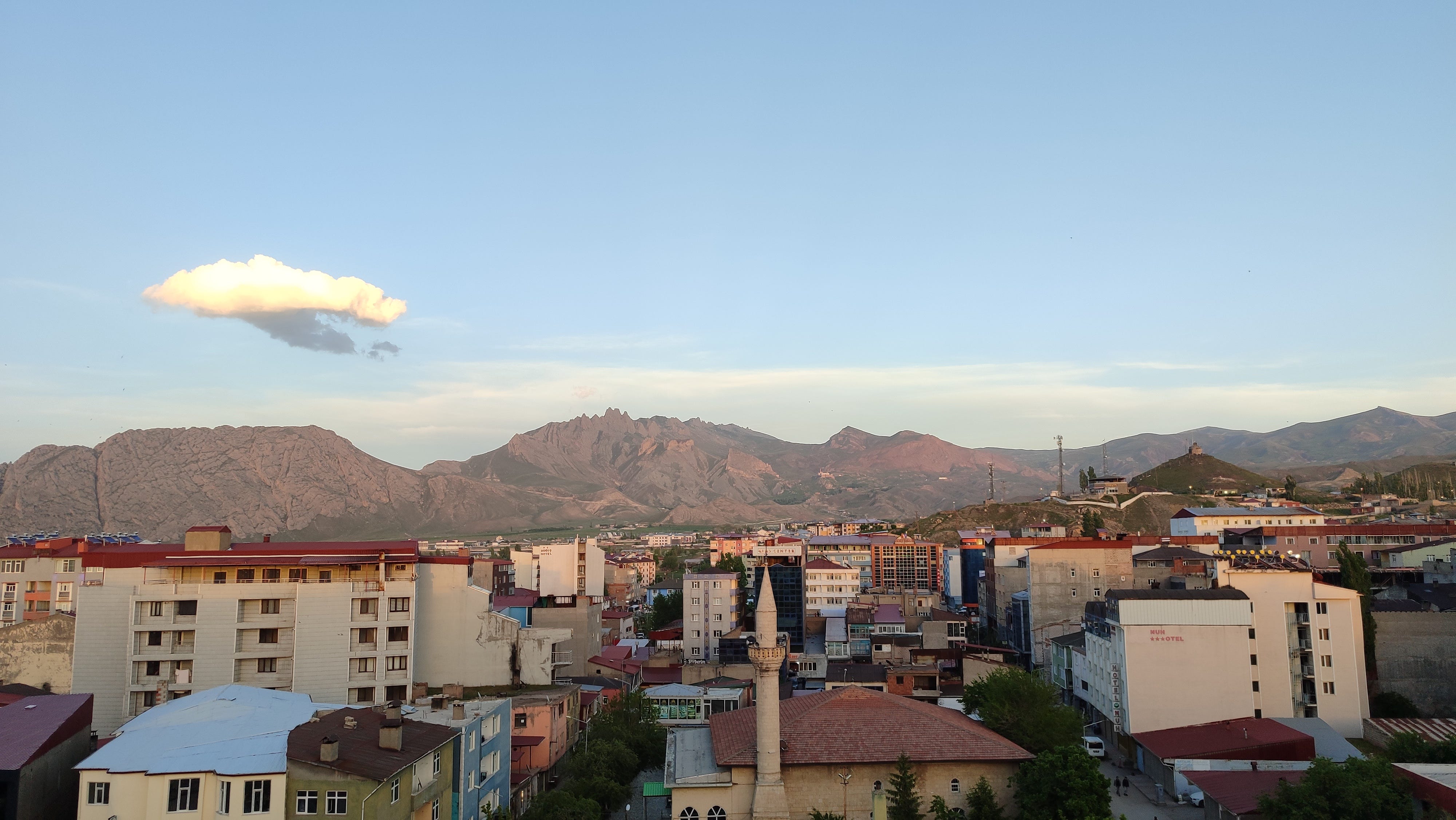
While waiting for the cloud to clear I burned off some of my Ararat fever walking the town photographing things I could find with pictures of the mountain on it and interrogating locals on where they felt was the best spot to see it, hoping that one of them would lead me up to their apartment or to their hotel and reward me with a secret view.
I’m not the only person to be captivated by Ararat. The mountain was only declared within Türkiye’s borders after the 1920 Turkish invasion of Armenia. Long before that it was Persian, whose legends see the surrounding region as the cradle of the human race.
But it is the Armenian people that honour and worship Ararat to this day. They believe Ararat houses the souls of individuals who protect it from invading armies and so for centuries believed the sacred mountain should not be climbed by mortals. There’s an Armenian legend of a hero chained to Ararat by evil spirits but once he escapes, the mountain will once again return to Armenia.
The mountain also captivates modern day explorers and theologians. Noah’s Ark is reputed to be resting on Ararat’s slopes and in 1916 a Russian alleged to have discovered the Ark frozen into one of the glaciers - but there is no evidence to verify this. In the 1970s, a group of Americans took photographs of the volcano and later spotted an object resembling the Ark in a photo - but later expeditions never found this location.
When one of my visits to the top floor provided a satisfactory weather report I dragged Jon from work to hit the town in search of the mountain. The flat terrain, along with higher buildings than the ‘70s was making it challenging to find a good view of the mountain we were so close to. We dipped into streets selling rocks with PKK leaders painted on them, and shops rugs featuring Ataturk (eternal) Erdogan (obligatory) Selahattin Demirtaş (revered) Ahmet Kaya (popular) and Imam Ali (religiously defining). We nibbled chocolate baklava and drank tea made with real slices of apples and as we got further out of town, teenage girls giggled at us and some got brave enough to ask for a photo, mostly drawn to Jon who has that washed out film star look about him.


We had got our Ararat bearings, and it teased us with glimpses in the distance between streets and taller buildings. We preserved in the sun past the military buildings on one side and the practice grounds on the other, treading the street between barbed wire and high walls, towards the Art Hostel on the outskirts of town, which I’d read had views.


Jon had picked up my mountain fever and made us press on until finally flat land opened up in front of us. We had the perfect view of Ararat, albeit with a tiny little cloud on top, like a hat.
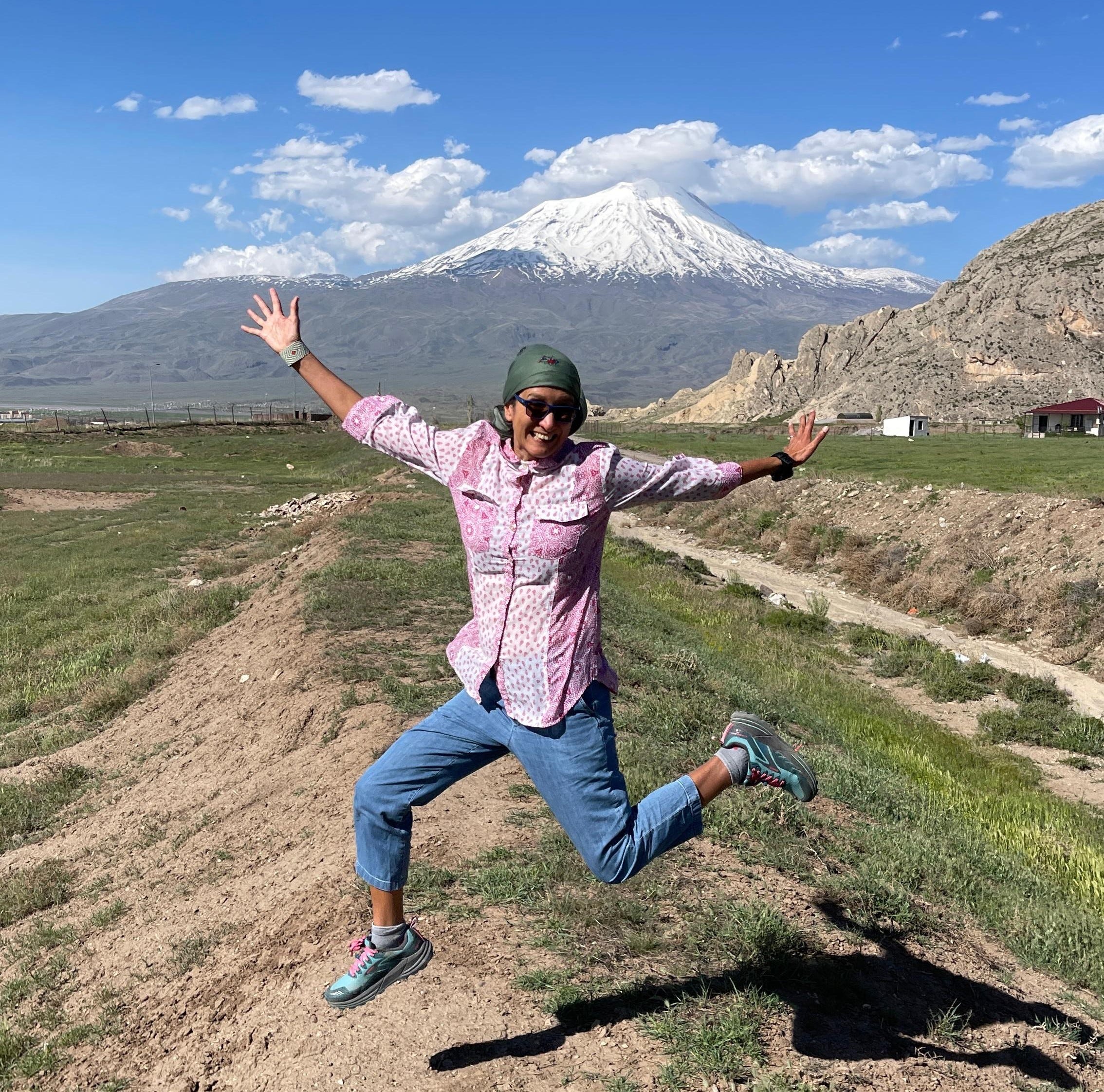
It was a well earned birthday present, the high altitude air, the blue sky as a backdrop, the glaring sun on our heads and this magnificent mountain of two peaks (Greater at 5000m and Little just under 4000m) with a tidy snow line like it had recently seen a barber.
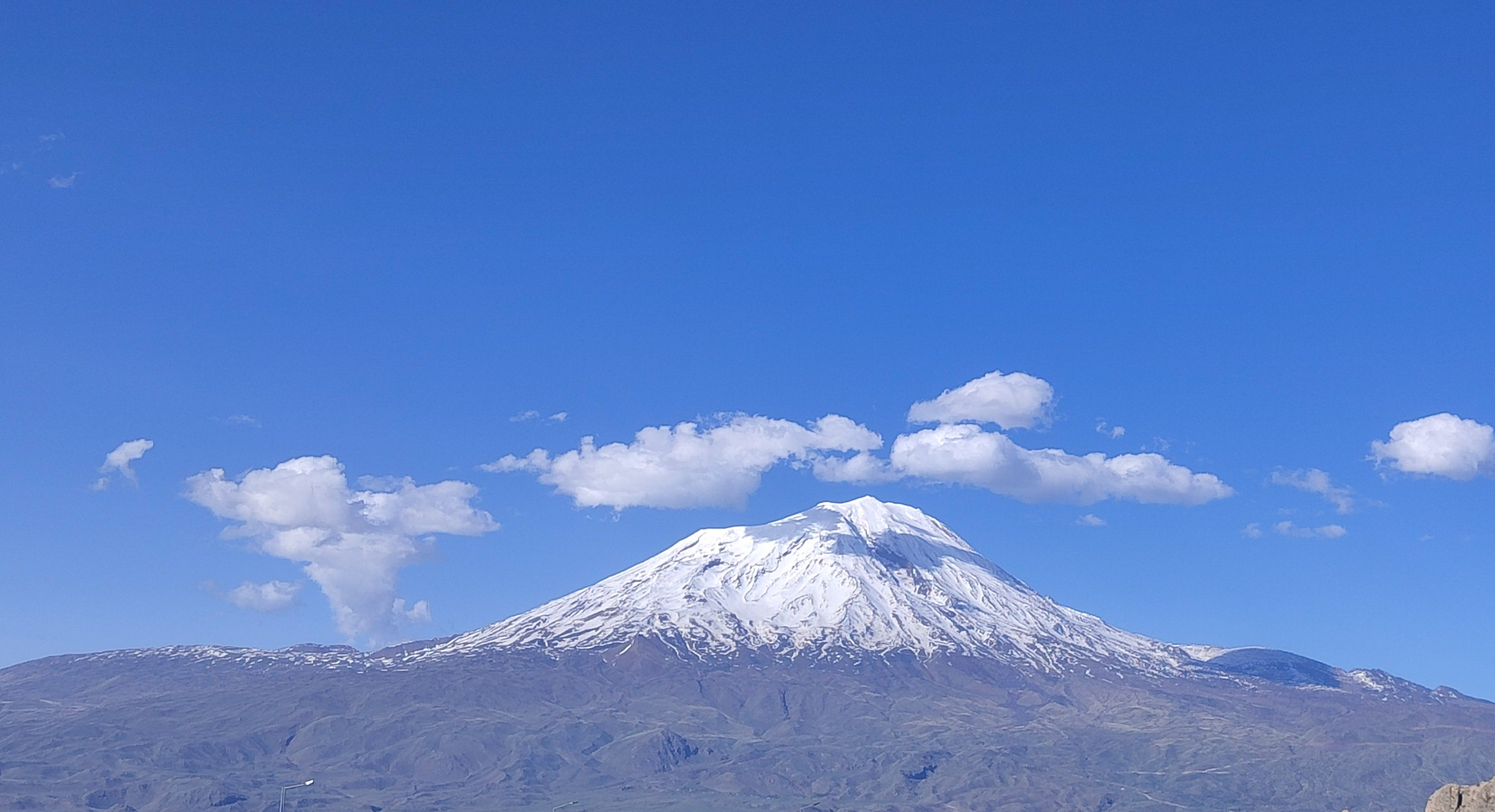
After a flurry of photos we started the long walk back and I kept turning around, checking on the mountain, watching for the little hat of a cloud to move. After a few kilometres, as the buildings started to obscure the view again, I noticed that the clould hat had drifted off and I became animated, suggesting that we should go back and look at it - one more time. But it was a long hot walk back, someone must need coffee, so we trudged back into town. Passing a block of residential flats, a young woman approached and asked if we would like to come to her house for tea. It was so surprisingly unexpected and we didn’t feel right about Jon entering her home, so we thanked her politely and generously, but declined. Moments later I regretted this, thinking seriously: she might live in a building with a really good view of Ararat. This mountain truly held me in its magic!
Note: Our visit was in May 2025. Sadly now the region is preparing for refugees coming from Iran, reports the Guardian: “Turkey has plans to manage mobility from the border in case of an influx, creating a buffer zone and establishing tent cities for up to 90,000 people. It has not yet been necessary, although there are four army and security service checkpoints for those driving from the border to Van.”
Fascinating region! We are almost birthday twins ;) the 19th May and a few years!
"keeping the many wives warm enough", I love that!