
Sukhothai mornings
Thailand, January 2025

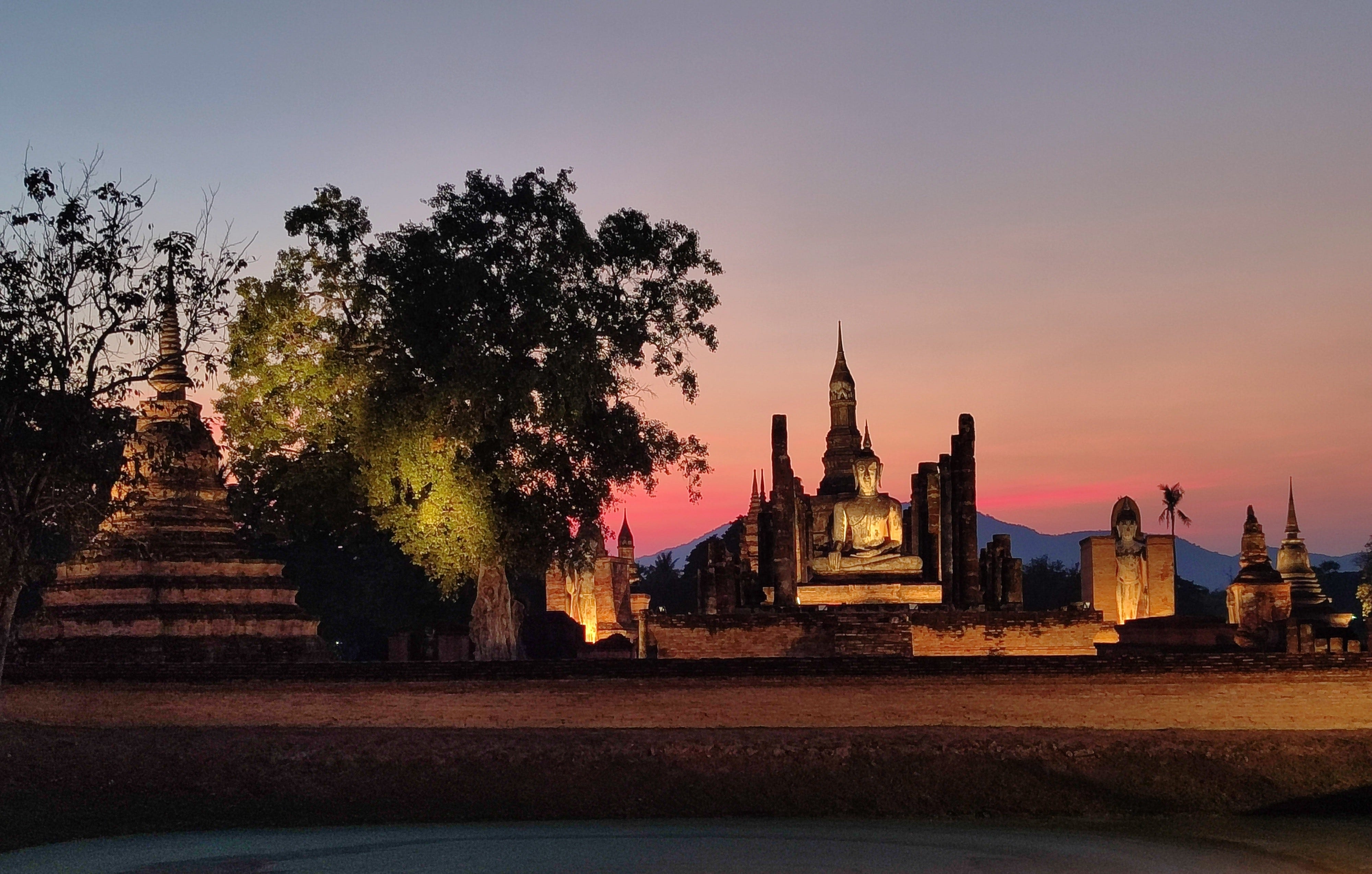
The ancient kingdom of Sukhothai is surprisingly lively in the morning. Emerging from the hotel in the grey pre-dawn light, I see two orange-robed monks gather at the brightly-lit tarpaulin of a roadside stall. Chanted prayers are given in exchange for food proffered by the stallholders. Stray soi dogs are at their most active at this hour. From my bed, I heard them howling at the moon like an eerie alarm clock. Now they sniff optimistically around the monk's robes.
Onto the main road, where the lakeside was lined with evening food stalls, now the streetside is lined with stalls selling offerings for monks, food and flower garlands and more, packaged in paper bags. Foreign tourists hover nervously at the end of the bridge, some sitting awkwardly on the mats on the floor in hiking pants and synthetic fleeces, careful to stay down the line, away from where the believers and faithful sit. The foreigners' heads turn like meerkats, unsure of what will happen. Tak Bat, the receiving of alms and saying of blessing takes place every day before dawn at the temple of Wat Traphang Thong.
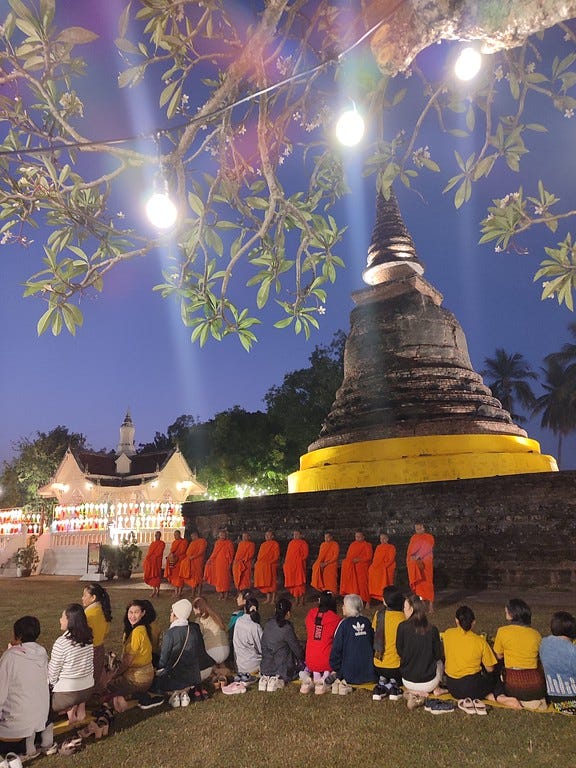
On Saturdays, the prayers seem longer, there’s more Thai tourists. A microphone is wielded by a civilian compere that talks about the temple in Thai before handing over to a monk to lead the prayers. There’s a chant where everyone joins in, and a Thai tour guide moves into position to get video footage of her group praying. The monks start to proceed down the line, and the soi dogs, who must receive many unwanted donations from the monks, move into position as if to remove the middle man. The gift bags that the tourists give are too bulky for the monks’ bowls so the procession is closely shadowed by civilians, a boy and young man, who take the bulky items from the monks and transfer them to a cart that will go back to the monastery.
And so it continues until the length of people have finished. I don’t know where the monks go after this because once the procession starts, I move away to stare at the pink hues bleeding into the grey of the sky, to make my own prayers for a day with no pollution and for blue skies not clouded by the carcinogenic particles that pollute the air above Thailand at this time of year.
Today a female monk, clad in white, takes my arm and guides me to the temple. Shoes off, I follow her inside and sit on the straw mats in front of Buddha, my legs folded underneath me. After what seems a respectable time, I make to leave. But she signals me to sit, this time cross-legged with hands in my lap. There is little inside the temple, just Buddha and the bare walls. It's up to me to meditate until I feel I have paid enough respects to satisfy my monk companion.
Leaving her meditating, I make haste before the sun shines, heading out to the western complex of temples, paying my 100 baht fee to cycle along the old city walls, the land around me sinking and rising where ancient moats would have surrounded the old town. The temples are further apart here, the roads are quiet, empty except at every official temple location, a worker is head-down sweeping the huge crispy leaves into a pile. I greet them with a wai, sometimes stopping for a photo of the temple remains, sometimes walking up the stony wall-like rocks that form a path.
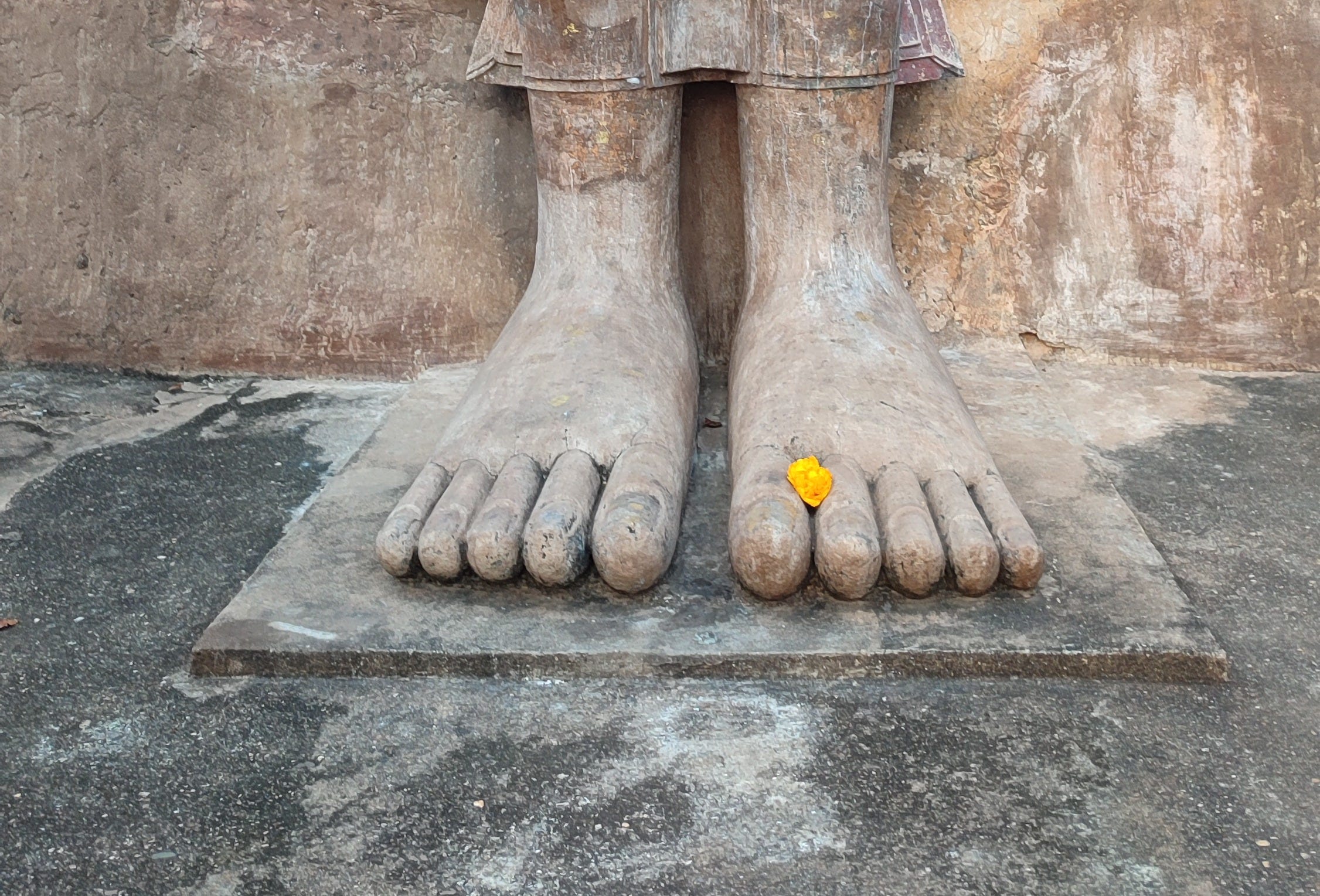
At the ruins of Wat Saphan Hin I stride up the high stone path going up the hill that gives the temple its name. Someone has laid fresh arrangements of yellow and orange marigolds at the feet of the standing Buddha. This tall Buddha is described as gazing out with peaceful strength but I see amusement gently reflected in the eyes and mouth. Buddha’s left hand is held in front of the body like a stop signal, to dispel fear it is said. I see the hand try to push away the dirty air. A stone pillar nearby translates to tell me that an ancient king used to ride his white elephant up this hill during full moons.
Flowers have been placed in the outstretched palm of a Buddha seated down the hill, and garlands are draped from the fingers. The pollution is a dirty smudge low on the horizon, making the sun streak like fading orange highlighter pen. Low cloud hangs across the trees. It would be pretty if not lethal.
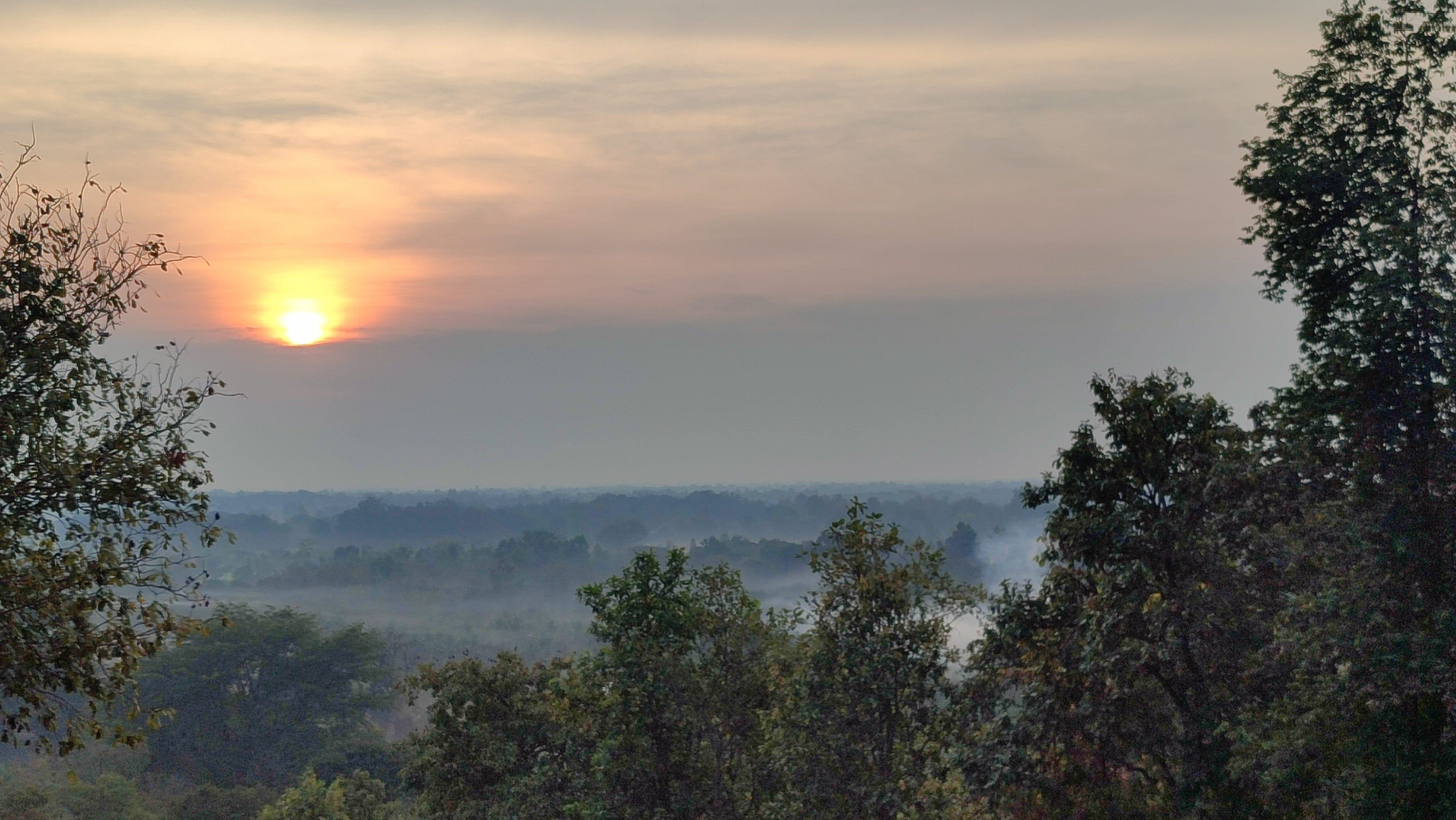
By the time I reach the temple of Wat Si Chum I have my jumper tied around my face, my head is pounding. The Buddha here sits in a mondop, a now roofless building. Buddha peeks out at me from a long narrow slit, as if afraid of what might be outside the ancient brick walls. This Buddha’s features are kind, almost smiling, and is known as the Buddha who is unperturbed. Buddha's fingers, pointing down at the Earth goddess, now point at the earth we have destroyed. Buddha's nails are adorned with gold leaf paper placed by contemporary worshippers. What would Buddha think of the extraction, the refining, the hammering, the production of this decoration dangling from the fingertips?
At Wangkorn, the temple of the dragon, I feel far away from the village surrounding the central temples. Trees command my attention, their dusty grey roots climbing over thick banyan tree trunks. The reverence for trees is my favourite part of Buddhism, and I stand under it, ready to receive enlightenment.
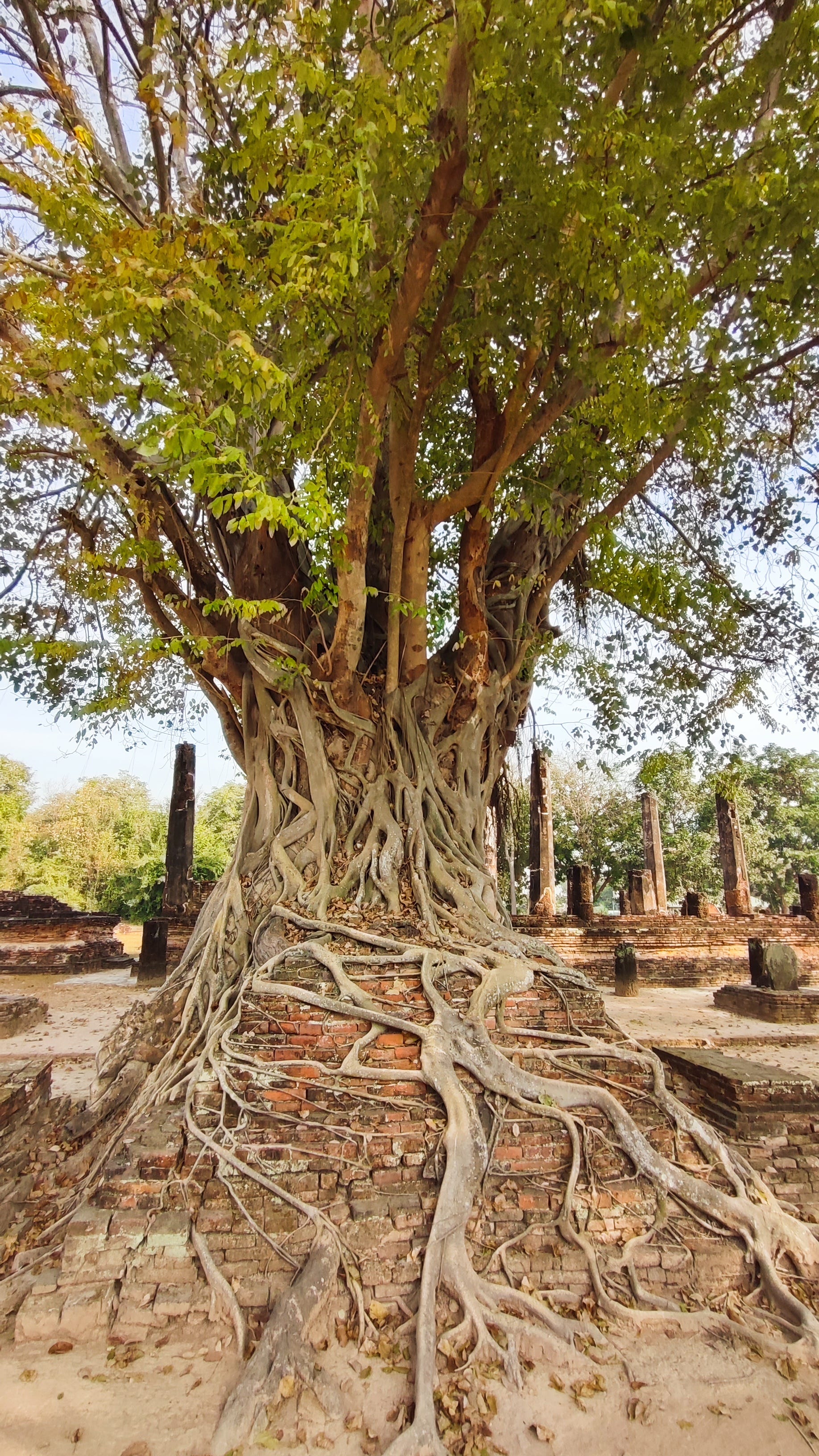
But my only enlightenment is that my lungs can't continue. I'm starting to wheeze. My throat is itchy. I pedal back to town to retreat indoors. Jon has not ventured outside and holds up the Bangkok Post and the day's air quality readings. 58 out of 77 Thai provinces have dangerous air quality, several times higher than the amount of microscopic particles that it is safe to breathe.
Υellow and orange, the colour of the marigolds, the brightest colours in a morning of greyed hues, is offered to Buddha to symbolise our renunciation to a higher being. But this morning it feels like we have surrendered to humanity’s lowest.
_______________
Sukhothai historical park can be reached from the town of Phitsanulok, a town on the stopping train between Chiang Mai and Bangkok. From there it’s a 60km cycle ride (air quality permitting) or seek a morning bus from Phitsanulok bus station. New Sukhothai is about 12km from the historical park and I’d recommend staying as close to the temples as possible, to see them at different times, lights and to witness the monks receive alms around your hotel. Cycling is the best way to get around the temples and they can be hired near the main entrance. Most people visit for a day, we stayed for a week.
I love the picture of the tree. Too bad about the air quality.