
The threads that bind us
Connecting with the Rohingya cause in Chiang Mai

People come to Chiang Mai for elephants and temples, but in the University’s new library, I found a stitched story that connected me to our time in Burma. We were in Burma in 2019 to visit a friend working there; we also had a contract for Relief International; and less common, as sport tourism - we participated in a community event called the Kalaw Run which had been taking place for four years but hosting the first ever ultramarathon in the country!
It was as good a time to visit as there could be in the country’s troubled history: Burma was in a faltering democratic transition, with intensifying conflicts, especially in Rakhine and Shan states. Persecution of the Rohingya continued. Behind the facade of civilian rule there was increasing military control, dissent was suppressed and international watchdogs were pointing at a multitude of human rights abuses.
Burmese people were generally welcoming of foreign visitors, and more than 4 million foreigners travelled to the country in the year we did. While some regions, like Rakhine State, had heightened caution, tourists could visit areas including Yangon, Bagan, Inle Lake, and Kalaw. There was of course great discussion on the ethics of traveling to Burma, awareness that some spends could benefit the government or military, and the need to spend mindfully as a result. This was balanced against the desire to show solidarity, connect and communicate with the people of the country. Where we went, we met ordinary people grateful to have the chance to connect and tell us about their lives.
We travelled to the former capital of Yangon, midway on the country’s north-south axis to Naypyitaw, the newer administrative capital, the ancient city of Old Bagan, the former Royal capital of Mandalay, the Shan state village of Kalaw and the floating villages of Inle Lake. We only saw a small portion of the country in our month there, limited by transport, but mostly access. In each state, town and village we realised there were many distinct differences to the people we were meeting, and the culture we were experiencing.


Burma is a multi-ethnic, multicultural, and multilingual country with more than 100 ethnic groups and as many languages. The connecting link was that everyone was incredibly friendly, kind, gifts were plentiful, and tea was shared. But one group we sadly did not come across was the Rohingya.
The Rohingya crisis
The Rohingya are an ethnic group of 1.4 million people in Burma that has been declared stateless by the government’s decision to not recognise them in the 1982 Burmese citizenship law. That’s the equivalent population of Sofia, Bulgaria declared stateless! This controversial law recognises 135 ethnic groups (an arbitrary colonial-era invention used by the military to divide and conquer) in the country - the Rohingya were a notable exception. Today many in the junta call them not Rohingya but Bengali to create a false narrative that the Rohingya have no right to live in Burma.
This discrimination is not new. While ethnic divide can be traced back to colonial days, it deepened when the military junta took control of the country in 1962. The Rohingya were systematically deprived of their political rights, coming finally into the international media spotlight in 2015, as thousands of Rohingyas fled from Burma in boats to escape violence and persecution, to nearby SE Asian countries. In 2017 the military began “clearance operations” against the Rohingya in northern Rakhine state, brutalising thousands more, and driving hundreds of thousands out of the country into neighbouring Bangladesh while their villages burned, which led to a huge swelling of numbers in Cox’s Bazar - now the world’s largest refugee camp. Since 2017, over 700,000 Rohingya have fled to Bangladesh, bringing the total in the Cox’s Bazar camps to nearly 1 million people. Controversially Burma’s civilian leader who had been hailed as a symbol of peace and tolerance, Aung San Suu Kyi, defended the state’s actions at the International Court of Justice, downplaying the military’s atrocities as a response to internal conflict.
Chiang Mai and Burma: a shared history
Burmese people have always been in Chiang Mai: historically parts of the region were part of the Burmese kingdom; there are colonial trade routes through the north, such as when timber was a peak commodity, and more recently through migration and displacement.
Rohingya refugees are also in Chiang Mai, and are particularly vulnerable as Thailand is not a signatory to international refugee conventions. Six underage Rohingya who went missing from a government shelter in Chiang Mai in March 2025 are still unaccounted for. The city’s multicultural history means Rohingya can blend in, sometimes as Burmese Muslims due to fear of persecution, trafficking or reprisals, but slowly community members are coalescing to form support networks, and advocate for their rights and importantly celebrate their culture before it’s lost.
Stitches of strength: The Cox’s Bazar quilts
Chiang Mai is a significant hub for Burmese academics and students, primarily through Chiang Mai University and the Regional Center for Social Science and Sustainable Development. It is through this department that I was able to make connections with a Rohingya women’s rights project that took place in Cox’s Bazar. Chiang Mai University hosted an exhibition based on the work that the non profit Asia Justice and Rights has done with more than 100 Rohingya women that they brought together to share their stories through the making of panels for quilts.
“The fundamental aim was to create an environment where women could be heard, regardless of education, literacy level or age, and to encourage a focus on the future rather than reliving past traumas.” writes Cleo Herre and Demet Yolcu in Stitches of Strength, a booklet which accompanies the exhibition. “Despite having endured unimaginable suffering and trauma, these women continue to look to the future with hope for their children, their communities and themselves.”


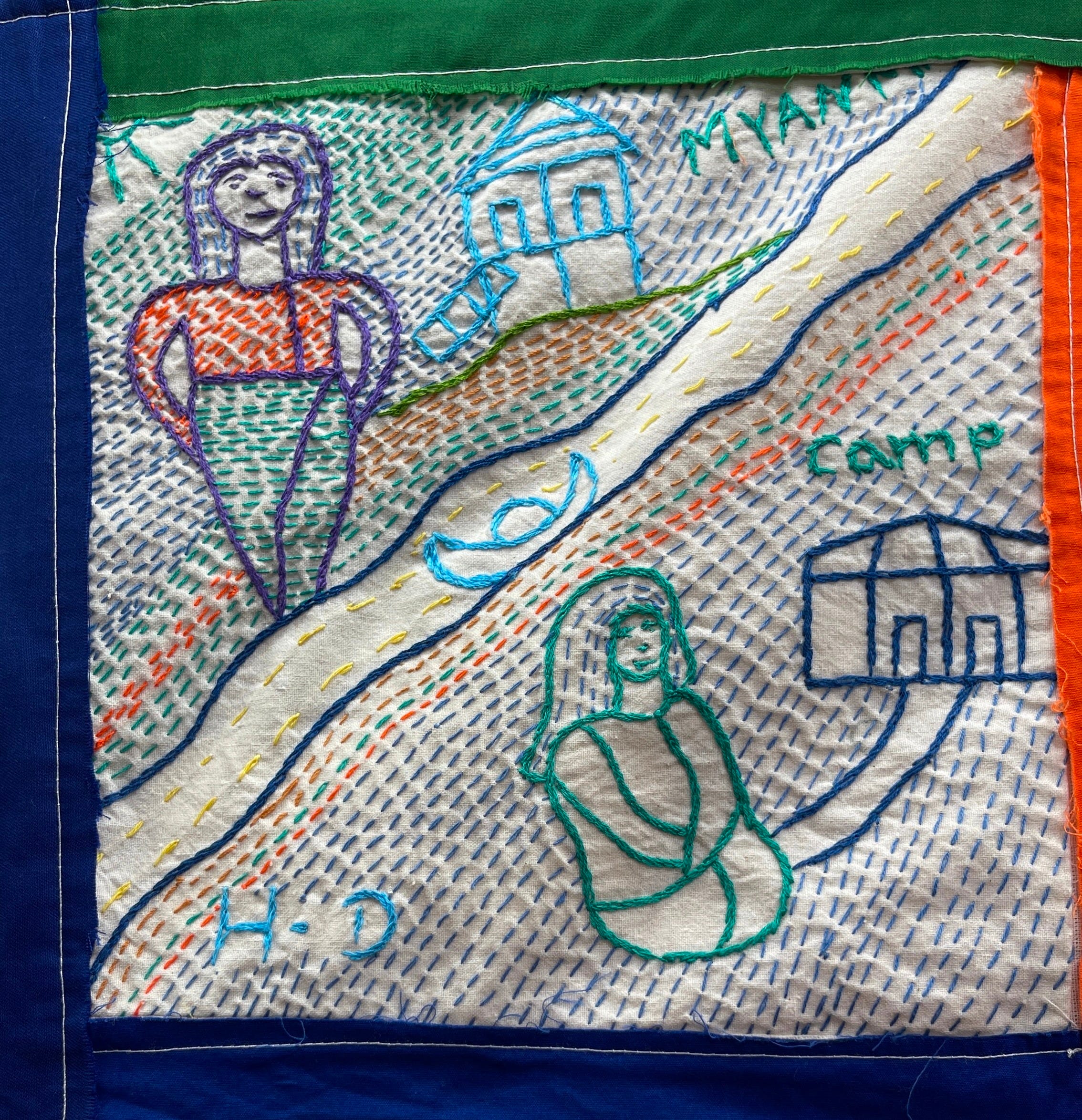
The quilts consist of individual panels, some contain stitches of home, expertly woven to belie this is not the first time they have held a needle. Others are less deft but still stark - messages are sometimes written in English as some of the refugees are losing their language as their culture is eradicated, while others are learning new skills such as English. They bear their names, their hope, but also heart-breaking messages. The messages in each panel focus on gender based violence, the role of men but also their rights.
A series of panels are made into the shape of a hand where the women explore the meanings and memories hidden in their hands.


“They spoke of the hard work their hands did, the lives they shaped, and the opportunities they were able to seize, however limited,” Cleo Herre and Demet Yolcu explain. “Through this collective discovery, the women revealed symbols of resistance, courage, and strength embodied in their hands. When many hands come together, women can achieve many things, including challenging the stereotypes that limit their roles both at home and in society.”
One of the AJAR staff pointed out a panel whose words in Rohingya were now upside down and translated for me: ‘we can do whatever we want with our own hands.’
Common enemy and common hope
With the military and government long promoting a narrative that the Rohingya don’t belong, the Buddhist majority population largely went along with it and animosity was widespread for this group of people who were unjustly labelled as illegal immigrants, making it easier for the government and military to enact genocide. People reading this in western countries might find this hard to believe, but I can barely think of a northern / European / Western country today whose government is not blaming the country’s ills not on state failure, but on “immigrants”.
The most recent coup in 2021 has brought a shift in the majority Burmese perception inside the country and between the various communities. There is now a realization that the people in Burma face a common enemy. In one of the quilts, the Rohingya women collectively created panels with messages of solidarity with Kachin and Ta’ang peoples, whose armed ethnic groups have fought intensified attacks against the Burmese government for autonomy and control over resource-rich areas.
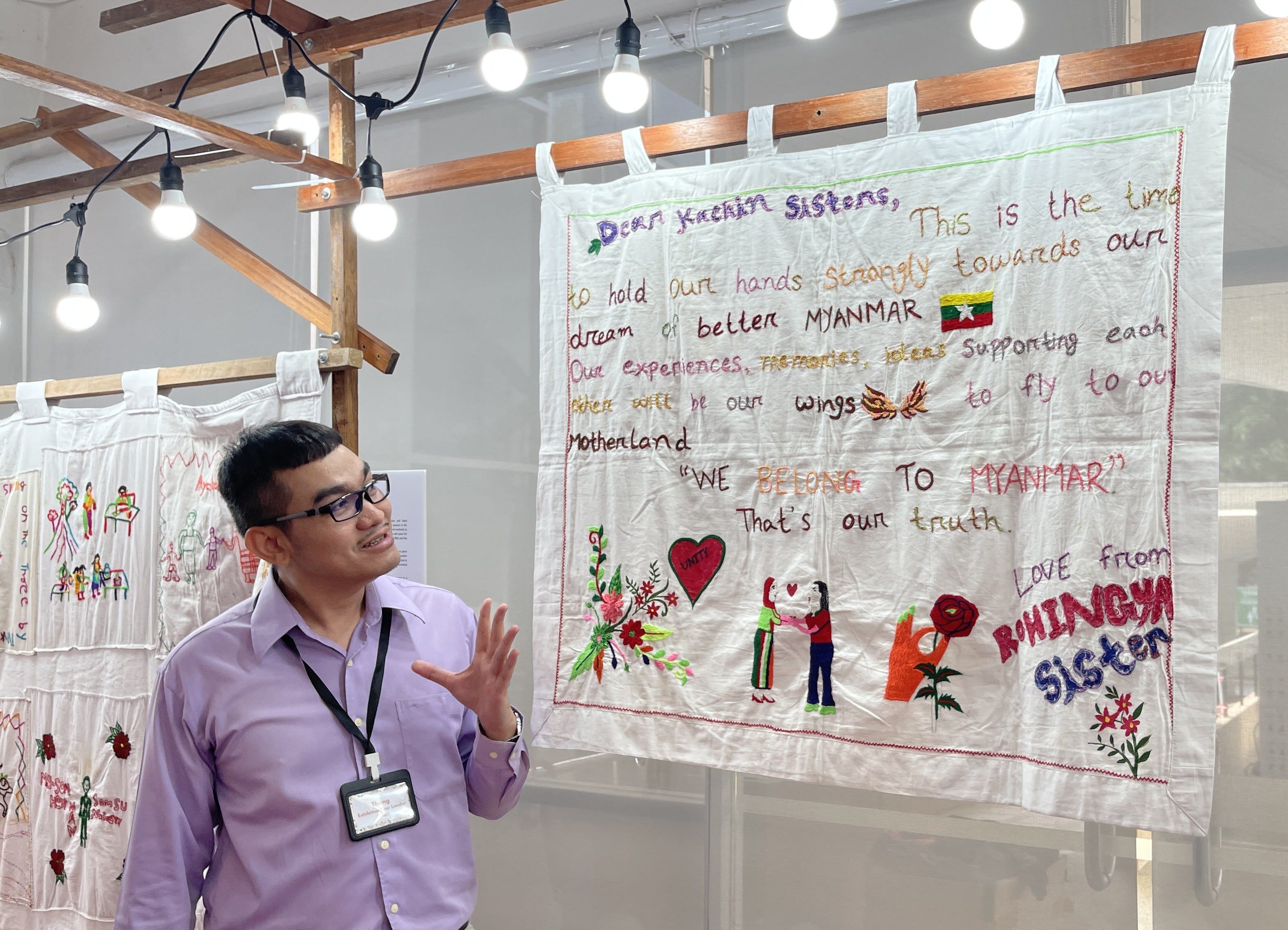
The quilt exhibition was a moving display and an opportunity to meet some of the people who had been working on these projects. It also offered an opportunity to add personal stitching of support to a panel which will be taken back to Cox’s Bazar to show solidarity, and I was heartened to see many female Thai students instantly taking up needle and thread. This interaction is critical. The Thai media have historically portrayed Rohingya in a demeaning manner, perpetuating the illegal immigrant position. In Chiang Mai, where there is a swelling of undocumented migrants due to porous borders in the hills, there are fears about job security which are easily exploited. Many city residents do not have any contact with the Rohingya community, who may be concealing their identity and this in itself contributes to that “fear of the other” we see being replicated all over the world.
This contact in Chiang Mai is critical - the Lanna Kingdom has always been diverse and negotiation, tolerance and acceptance of other cultures is part of the region’s historical makeup. The region’s history also has echoes of being misunderstood, controlled, or culturally diminished. Reflecting on this history as the students stitch a message of solidarity we can hope that there is more that unites than divides; that those students at the University, at RCDS and AJAR become the leaders of tomorrow who can use Thailand’s quiet diplomacy and ASEAN influence to play a more critical role in stopping the genocide of the Rohingya.
“Note: I use the name Burma in this text, as ‘Myanmar’ remains a designation adopted by the military junta without the consent of the population, but I retain its use when talking about the Myanmar military.